

Is A Plant Cell Eukaryotic Is A Animal Cell Eukaryotic Or Prokaryotic
A Cell is the smallest structural and functional unit of life. Typically, in that location are two types of cells, i.e., prokaryotic and eukaryotic cells. Prokaryotes are pre-existing cells and eukaryotes evolved later on. Both plants and animals cells are eukaryotes. Both share and then many structural and functional similarities yet contrasting characteristics.
A plant cell structure is very similar to that of the animal jail cell, the 2 types of cells contain many of the same organelles. These organelles bear out the same functions in both types of cells. Bated from common organelles, found and animal cells are very unlike. Plant cells are very unique because of the presence of iii boosted structures. These structures (a jail cell wall, vacuoles, and plastids) are important to a plant'south power to function.
What is a Institute Cell?
Plant cells vary considerably in size, shape and structure. It is, therefore, difficult to nowadays a general motion-picture show of establish cells. Typically, constitute cells are cubic or rectangular in shape and a lot bigger than animal cells in structure. They are very unique considering of the presence of three additional structures. These structures (jail cell wall, vacuoles, and plastids) are important to a plant's ability to office.
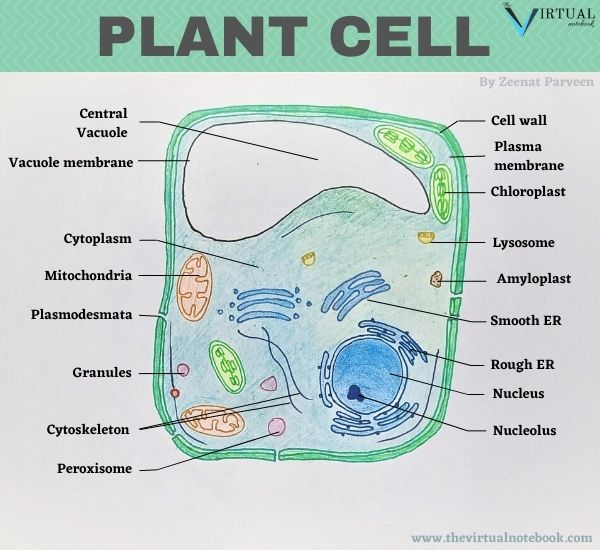
The cytoplasm of found cells is an aqueous medium of different viscosity and composition which contains membrane-bound bodies known every bit organelles. Also embedded in the cytosol are chloroplasts (plastid), mitochondria, ribosomes, Golgi appliance, peroxisomes, glyoxysomes, spherosomes, microtubules and microfilaments (part of the cytoskeleton).
What is an Fauna cell?
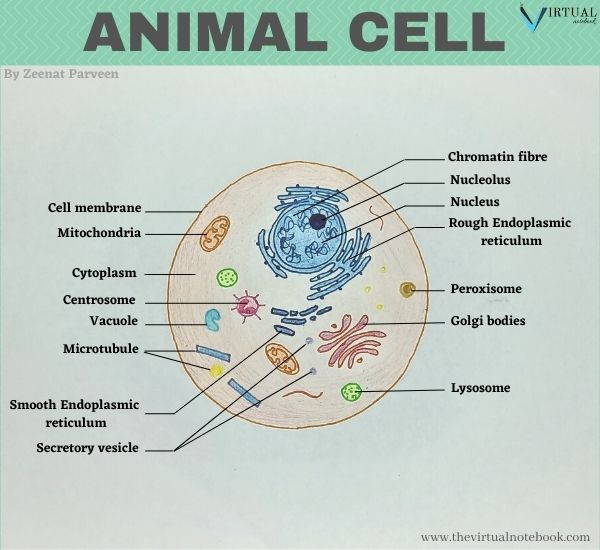
Like plant cells, they are as well eukaryotic cells but lack an outer cell wall. They have a true membrane-bound nucleus along with other cellular content. Animal cells are mostly smaller in size equally compared to constitute cells and may contain more than than ane vacuole.
Similarities between constitute prison cell and fauna cell
- Ribosomesouthward: bothe cells take ribosomes.
- Endoplasmic Reticulum: it is nowadays in both plant and brute cells.
- Mode of reproduction: both have like reproduction process of Mitosis and Meiosis.
- Both have prison cell membrane or plasma membrane
- plant prison cell and creature jail cell take well defined nucleus, cytoplasm, mitochondria, peroxisomes, vacuoles and DNA as their genetic fabric.
- Cytoskeleton System: both cells have well-develped cytoskeleton system.
Difference betwixt Constitute cell and Animal jail cell
Morphologically, animal cells are smaller than plant cells. They both have differences in their shape and sizes. Lets discuss various differences in particular.
What is establish/beast cells?
Plant cell: Plant cells accept a membrane-leap nucleus and vary greatly in size, form, structure, and function. Some are measured in micrometres, others in millimetres, and withal others in centimetres (fibres in sure plants).
Animal cell: An creature autumn under the category of eukaryotic prison cell that lacks a jail cell wall and has a true, membrane-jump nucleus along with other cellular organelles.
Plant prison cell vs animal cell organelles
Although the plant cell structure is very similar to that of the animal jail cell, the ii types of cells contain many of the aforementioned organelles. These organelles carry out the same functions in both types of cells. Aside from common organelles, plant and animal cells are very dissimilar.
Found cells are very unique considering of the presence of iii boosted structures. These structures (a jail cell wall, vacuoles, and plastids) are of import to a plant's ability to office.
A plant/animal cell has diverse cell organelles:
- Jail cell wall: It is the outermost boundary of the eukaryotic plant jail cell. Due to the presence of cell wall, the structure of constitute jail cell is more than rigid than brute prison cell. However, information technology is absent-minded in creature cells.
- Cytoplasm: Information technology is thick semi-fluid substance of the prison cell lying just beneath the prison cell membrane. It is present in both plant and fauna cells.
- Plasma Membrane: It separates the interior of the cell from the ouside environment and present betwixt the cell wall and the cytoplasm. Information technology is nowadays in both types of prison cell.
- Nucleus: It contains the pattern that determine the structure and function of both establish prison cell and creature jail cell. Information technology is nowadays in both types of cells. Although, it is the largest organelle present in animal cell while not a instance found cell.
- Ribosomes: They are protein builders/synthesizers of the cell. They are present in both cells.
- Cytoskeleton: it is a network of interconnected protein filaments and tubules that extends from the plasma membrane to the nucleus in both animal and constitute cells. In brute cells, Microtubules (of cytoskeleton) usually radiate from the centrosome located almost the nucleus. On the other hand, they are more than near the plasma membrane in plant cells.
- Golgi complex: It is an organelle that sorts and modifies proteins and lipids (fats). They are nowadays in both the cells. These minor connected units are called dictysomes in found cells instead of golgi bodies.
- Endoplasmic Reticulum: information technology is an organelle that contain a series of flattened sacs inside the cytoplasm. Its main function is to change and synthesis proteins in eukaryotic cells. Once more, it is present in both plant cell and anima jail cell.
- Plastids: These are double membrane-bound organelles that prove great variations in shape, size and numbers. They are only present in constitute jail cell while absent in animal cells.
- Mitochondria: They are also double membrane structures and are oftern called the power house of the prison cell. Plant jail cell contain fewer mitochondria than animal cells.
- Vacuoles: Together with the presence of plastids and cell wall, the vacuole is ane of the 3 characteristics that distinguish institute cell from an animal prison cell. Vacuoles are present in both the cell but vacuole in constitute cell is larger than vacuoles in creature prison cell. Vacuole is also permanent in constitute cell whereas it is temporary in animalc cell.
Size
Institute cells are much larger than beast cells. The normal range for an animal cell varies from x-xxx μm while that for a plant cell stretches from 10-100 μm.
Shape
Plant cells show a wide range of shapes and internal structures, depending on their function. Typically, constitute cells are cubic or rectangular in shape and a lot bigger than brute cells in structure. On the other paw, beast cells are irregular due to the absence of a cell wall.
Cilia and flagella
Cilia: they are small, slender, hair-similar structures present on the surface of eukaryotic cells. They are of two types: Motile and not-motile.
Flagella: Information technology is also a lash-like structure that protrudes from the jail cell body.
Cilia and flagella assistance in the locomotion and sensing of the extracellular environments. They are present in animal cells whereas absent in found cells.
Plasmodesmata
These are pores or channels present in the jail cell wall of plant cells. They link adjacent plasma membranes and cytoplasm. Also, they assistance in the communication and transport of materials beyond plant cells. As they are simply present in the cell wall, they are unique to plant cells. Hence, absent in animal cells.
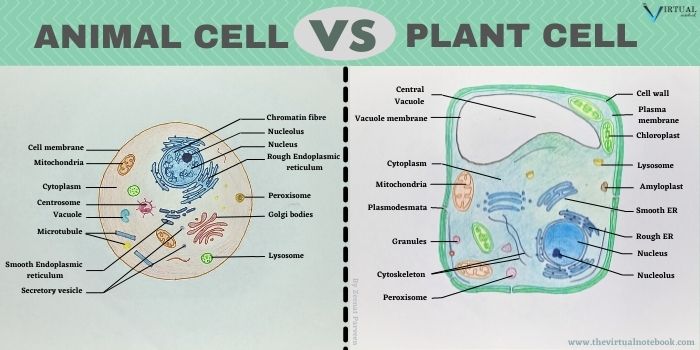
Found jail cell VS animal cell diagram
Plant cell VS animal cell table
| CHARACTERISTICS | Beast Jail cell | Constitute CELL |
|---|---|---|
| Definition | These are eukaryotic cell that have plasma membrane as their outermost organelle. | They are also eukaryotic cell that have prison cell wall every bit their outermost membrane along with other different organelles. |
| Kingdom | Animalia | Plantae |
| Size | smaller. Size of cell varies from 10-xxx μm. | Larger than animal cells. jail cell varies from 10-100 μm. |
| Shape | They are round to irregular in shapes | They vary greatly in size, form, structure, and function. Establish cells are cubic or rectangular in construction. |
| Cell wall | it is absent. | Cellulose prison cell wall is nowadays. |
| Effect of hypotonic solution | Animal cells tin can easily bursts when placed in hypotonic solution because of the lack of a cell wall | They do not outburst in a hypotonic solution due to the presence of a jail cell wall. |
| Largest organelle | Nucleus | Plastids |
| Golgi bodies | Well developed Golgi bodies are are that have two cisternae. | It is present in the form of units known as dictyosomes |
| Centriole | Nowadays | Absent in college plants but some lower plants practise have centrioles. Instance: Algae, chlamydomonas |
| Mode of nutrition | Heterotrophic | Autotrophic |
| Ability to make own nutrient | As they are heterotrophic, they cannot produce their own food. | They can synthesize their ain nutrient. |
| Chloroplast | Absent | Present. It enables plants to perform photosynthesis. |
| Vacuole | Present but smaller than found cell. | It is too present but much larger than brute jail cell. |
| Nature of vacuole | Numerous and temporary | One, permanent and central vacuole is present in mature institute jail cell. |
| Cell Membrane | It is the outermost membrane in animal prison cell that encloses the cellular contents. | Information technology is present below the cell wall in found cells. |
| Cytoplasm | It houses all the cell organelles. | It houses about of the cell organelles. |
| Centrosomes | Present | Absent |
| Plastids | Absent | Present They provide color to the plants and helps in trapping the light free energy. |
| Cilia | Information technology is present in certain cells. Example: epithelium lining of respiratory tract. | Absent |
| Flagella | Certain animal cells have flagella. Example: spermatozoa | It is absent. |
| Mitochondria | They are present in abundant | They are also present in constitute jail cell but their number is much lower than animal cells. |
| Plamodesmata | Entirely absent-minded in animal cells. | Nowadays in the cell wall of plant cell. |
| Microtubules | Microtubules (of cytoskeleton) usually radiate from the centrosome located about the nucleus. | they are more near the plasma membrane in plant cells. |
| Nucleus | Present. It is the largest organelle in animal cells | Present. It is not the largest organelle in plant cell. |
| Lysosomes | Nowadays | Rarely present every bit the plant vacuole and the Golgi bodies handle molecule degradation of waste cellular products. |
| Endoplasmic reticulum | it is nowadays | present |
| Microvilli | Present. Example: intestinal lining of digestive system | It is absent |
| Endosomes | These are membrane-bound vesicles present in the cytoplasm of all the animal cells. | Present. Plant endosomes have different structural and functional organizations as compared to creature cells. |
References
Cell biological science: organelle structure and function by David East. Sadava. Page no.241-263, page no. 295-303, affiliate 9
Cell biological science by David Due east. Sadava; CBS publisher; from page no. 213-225
Cell and molecular biology past Prakash S. Lohar; MJP Publishers; from page no. sixteen-xviii, 96-98, 115-117, 122-130
The cell: A molecular approach by Geoffrey Grand. cooper, fourth edition
Cell biology, genetics, molecular biology, evolution and environmental by P.S Verma and V.K. Aggarwal; page no. 146-148, 186-190
Essau's Plant Beefcake, third edition, chapter: The Protoplast: Plasma Membrane, Nucleus, and Cytoplasmic Organelles
Plant Biochemistry edited past P.K. Dey and J.B. Harborne, chapter no. ane: The plant, the cell and its molecular component
Essentials of biology, fifth edition by Sylvia South. Mader and Michael Windelspecht
Lehninger; principles of biochemistry past Michael 1000. Cox and David E. nelson, page no. 246,247, 795-96.
https://byjus.com/biological science/animal-cell/
https://byjus.com/biological science/difference-between-plant-cell-and-brute-cell/
https://biologydictionary.net/beast-jail cell/
https://www.thoughtco.com/all-near-creature-cells-373379
https://microbenotes.com/plant-cell-vs-animal-cell/
https://chemdictionary.org/beast-cell/
Source: https://www.thevirtualnotebook.com/plant-cell-vs-animal-cell-similarities-differences/
Posted by: baggettvirs1976.blogspot.com
0 Response to "Is A Plant Cell Eukaryotic Is A Animal Cell Eukaryotic Or Prokaryotic"
Post a Comment