

How To Draw A Project Wild Animals In Code
Pedagogy Alphabetize | Acquire TO FISH | Project WET | Projection WILD
 Project WILD is one of the most widely-used conservation and environmental instruction programs among educators of students in Pre-kindergarten through high school. Information technology is based on the premise that young people and educators have a vital interest in learning well-nigh our natural globe. Emphasizing wildlife because of its intrinsic value, Project WILD addresses the demand for human being beings to develop as responsible citizens of our planet.
For more details on the evolution and organization of Project WILD at the international level, visit www.projectwild.org.
- What is a Project WILD Workshop in Indiana?
Projection WILD explores an individual's understanding of wildlife and ecosystem sustainability to provide informed decisions to use natural resources wisely. In Indiana, we focus our training to our native wildlife and educator's needs. Project WILD curriculum and activeness guides:
- Are like shooting fish in a barrel to use
- Work indoors or outdoors
- Correlate with Common Core Standards, Next Generation Science Standards, and Indiana Land Standards
- Develop students' conceptual skills such as analysis, classification, clarification, interpretation, evaluation, inference, hypothesis formation, and problem solving
- Why attend a workshop?
Our workshops are designed for educators in both formal and non-formal settings. During the workshop, participants engage through professional development. Contact hours gained during a workshop are eligible for teachers to apply towards their Professional person Growth Plan (PGP). The framework of this workshop is to provide educators with:
- An unbiased approach to basic water resource management practices
- Hands-on curriculum and an activity guide
- Interdisciplinary lessons
- Scientific information
- Techniques and methods to teaching problem solving and decision-making skills
- Who can use Project WILD?
- General Classroom teachers – Pre-Grand - 12; all subjects
- Specialist Teachers – GT, Special Ed, ELL (check with your district about specialist credit)
- Educators in non-formal settings – nature centers, museums, zoos, parks
- Children/youth leaders – scouts, camps, youth groups
- What are the Projection WILD Curriculum & Activity Guides?
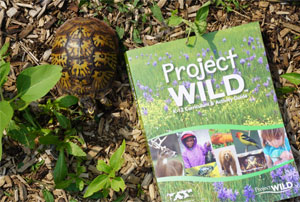
- Project WILD One thousand-12 Curriculum & Activity Guide: contains 81 activities concentrating on terrestrial wildlife, habitat, and ecological concepts.

Workshop Information:
- half-dozen-hour minimum
- $25/person workshop fee*
- Project WILD Sample Activeness
- Aquatic WILD G-12 Curriculum & Action Guide: contains 55 activities emphasizing aquatic wild fauna and habitats.

Workshop Information:
- vi-hour minimum
- No Fee* (in support by federal sport fish restoration funds
- May also be offered in conjunction with Project WET workshops
- Aquatic WILD Sample Activity
- Flying WILD K-12 Curriculum & Activity Guide: contains 43 activities offers field investigation with bird biology, conservation, and natural history.

Workshop Information:
- half dozen-60 minutes minimum
- $20/person workshop fee*
- Flying WILD Sample Activity
- Growing Upwards WILD early on childhood (ages iii-seven) Curriculum & Activity Guide: contains 27 activities that builds on children's sense of wonder about nature.

Workshop Data:
- four-hour minimum
- $twenty/person workshop fee*
- Growing Upwardly WILD Sample Activity
The guides incorporate wildlife-related concepts into classroom curriculum and each activity is designed to teach one or more of the following concepts:
- Sensation and appreciation of wild fauna
- Human values and the wild animals resource
- Habitat and ecological systems
- Wildlife conservation
- Cultural and social interaction with wildlife
- Environmental issues and trends, alternatives and consequences, ecological systems
- Responsible human deportment
Each guide includes quick-reference indices also as a glossary of terms.
*note that fees may vary depending on funding or extras included
- Project WILD One thousand-12 Curriculum & Activity Guide: contains 81 activities concentrating on terrestrial wildlife, habitat, and ecological concepts.
- What are the pedagogy standards?
Projection WILD recognizes that their materials must follow teaching standards to stay relevant in the classroom. Their curriculum guides follow:
- Indiana Bookish Standards
- Common Cadre State Standards for English language/Language Arts and Literacy in History/Social Studies, Science, and Technical Subjects
- National Science Didactics Standards
- Next Generation Science Standards
- Due north American Association for Environmental Teaching (NAAEE)'south Guideline for Excellence
Growing Up WILD (ages three-7) materials are correlated to:
- Early Learning, Indiana Academic Standards
- Head Outset Early Learning Outcomes Framework
- National Association for the Education of Young Children (NAEYC) Accreditation
- How was Project WILD developed?
- Each educator guide follows a conceptual framework that was developed through a rigorous process to ensure its accuracy, residual, and educational validity
- Written by classroom teachers and other educators, academy faculty, resource agency personnel, representatives of private conservation groups and other community representatives
- Was extensively field tested and evaluated for educatee accomplishment. The plan continues to be monitored and evaluated with changes made to the materials to respond to educator feedback and contain new information
- Each activity has been kid-tested and instructor-canonical
- Who recognizes Projection WILD?
- Indiana DNR, Division of Fish & Wild fauna
- Eligible for Indiana teacher'due south Professional Growth Programme (PGP)
- Association of Fish & Wildlife Agencies
- The Wildlife Society: Conservation Education Honour
- The National Ecology Education and Training Foundation in Washington, D.C. (CEE) National Environmental Education Achievement award for leadership in conservation educational activity
- Endorsed past the National Council for the Social Studies
- Consequent with recommendations of the National Scientific discipline Teachers Clan
- Where tin yous find a workshop?
Educators can register for upcoming workshops on our DNR agenda. If there is non an upcoming workshop or if you would similar one tailored to your education needs, nosotros can arranged a workshop for yous! Contact united states of america with a minimum of xv or more than people that would attend a workshops and we can organize a training in a location and on a appointment at your convenience.
- School and Group Programs
Indiana State Parks provide educational programs on-site and off-site. Each plan is designed for students and groups to acquire more about native wild animals in Indiana. To learn more, visit Land Parks School and Grouping Program website.
- Boosted Resources
Indiana Project WILD Contact
For questions about Indiana Projection WILD, email us at dfwed@dnr.IN.gov.

Source: https://www.in.gov/dnr/fish-and-wildlife/education-programs/project-wild/
Posted by: baggettvirs1976.blogspot.com
0 Response to "How To Draw A Project Wild Animals In Code"
Post a Comment